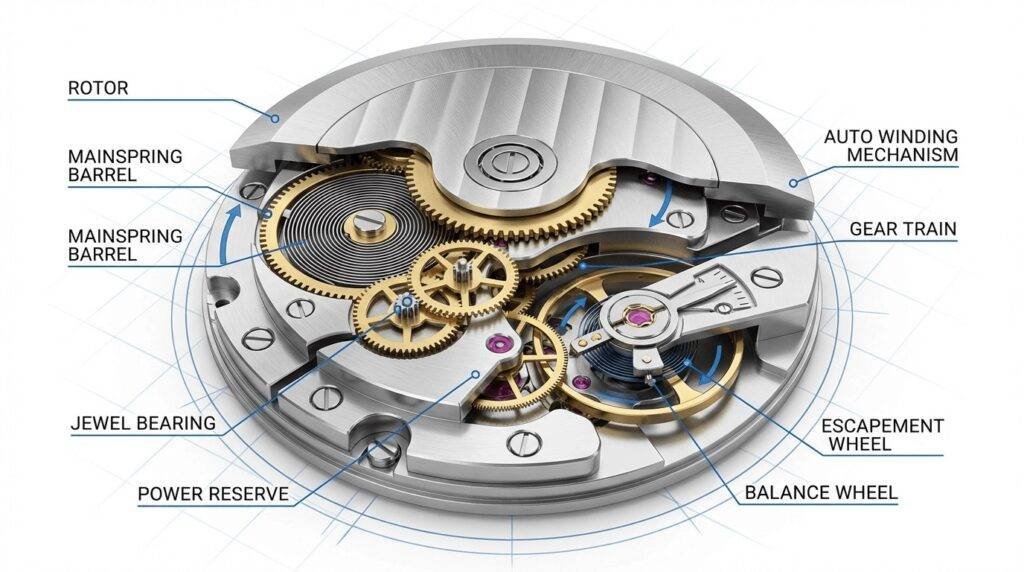
The world of horology is vast, but at its core, every watch is defined by its “engine.” This comprehensive guide to watch mechanics explores the intricacies of the watch movement, specifically focusing on the engineering marvel that is the automatic watch. Whether you are a seasoned collector or a novice looking to buy your first timepiece, understanding what happens behind the face of the watch is crucial. You will learn how these tiny mechanical parts work in harmony to track time without a battery, making this article an essential read for anyone who values craftsmanship over disposable technology.
Every watch requires a mechanism to measure the passage of time and display it via the hands of the watch. This mechanism is known as the watch movement, or calibre. Think of it as the engine of a car; while the case and dial provide the aesthetic appeal, the movement must perform the heavy lifting. In the world of horology, the type of movement chosen dictates not only the accuracy of the timekeeping but also how the watch keeps ticking over the years or even decades.
The watch movement is often called the heart of a watch because it is a living, breathing system of gears and springs. A high-quality watch movement is a testament to human ingenuity, often containing hundreds of microscopic components. When a watchmaker assembles these parts, they are creating a timepiece that can potentially last for generations. Understanding this internal world is the first step for any of the watch enthusiasts looking to deepen their appreciation for their watch collection.
To understand how automatic watches work, one must first look at the concept of energy. Unlike a watch with a quartz movement, which relies on a battery, an automatic watch captures energy from the natural movement of the wearer’s arm. This is achieved through a weighted component called a rotor. As you move your wrist throughout the day, the rotor spins freely within the watch, and this natural motion provides the torque necessary to wind the mainspring.
This process of automatically charging the watch ensures that as long as you are active, the watch run will continue uninterrupted. The energy from the mainspring is then released through a series of gear trains to the escapement. This self-winding capability was a revolutionary advancement in horology, famously attributed to the Swiss watchmaker Abraham-Louis Perrelet, who is often credited with developing the first automatic watch concept. It eliminates the daily ritual of having to manually wind the crown to keep the watch functional.
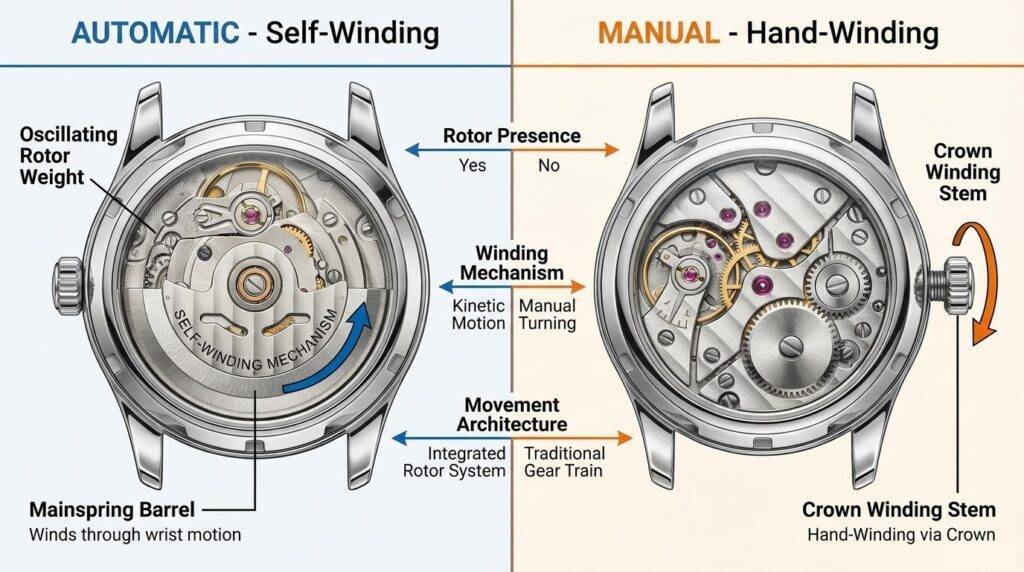
The main difference between automatic and manual and automatic mechanical pieces lies in how the mainspring is energized. A manual watch, or hand-wound timepiece, requires the wearer to physically turn the crown to wind the watch. This tightens the mainspring, which then slowly unwinds to power the watch. In contrast, an automatic wristwatch handles this task itself. While you can still wind the mainspring by turning the crown on most modern versions, the primary method of energy gain is the self-winding movement.
When comparing automatic and manual watches, many collectors prefer the automatic movement for its convenience. However, a manual watch is often thinner because it lacks the oscillating rotor. If an automatic watch hasn’t been worn for a few days, the power reserve will eventually run out, and the watch will stop. In such cases, the wearer might need to wind the watch manually to get the balance wheel oscillating again before putting it on.
To appreciate the complexity, one must look at the key parts of an automatic system. The mainspring acts as the power source of the watch, storing the potential energy. This energy is regulated by the balance wheel, which acts as the “pendulum” of the watch, swinging back and forth at a constant rate. Another critical component among the parts of an automatic watch is the pallet fork, which locks and unlocks the gear train, creating the iconic “ticking” sound as it interacts with the escape wheel.
The automatic watch movement also includes a complex automatic winding bridge. This contains the rotor and a series of reversing gears that allow the mainspring to be wound regardless of which direction the weight spins. In a modern automatic, these mechanical parts are often finished with beautiful decorations like Geneva stripes or perlage, visible through a transparent case back on the side of the watch. These components must be perfectly lubricated by a watch repairer during service to ensure the watch remains accurate.
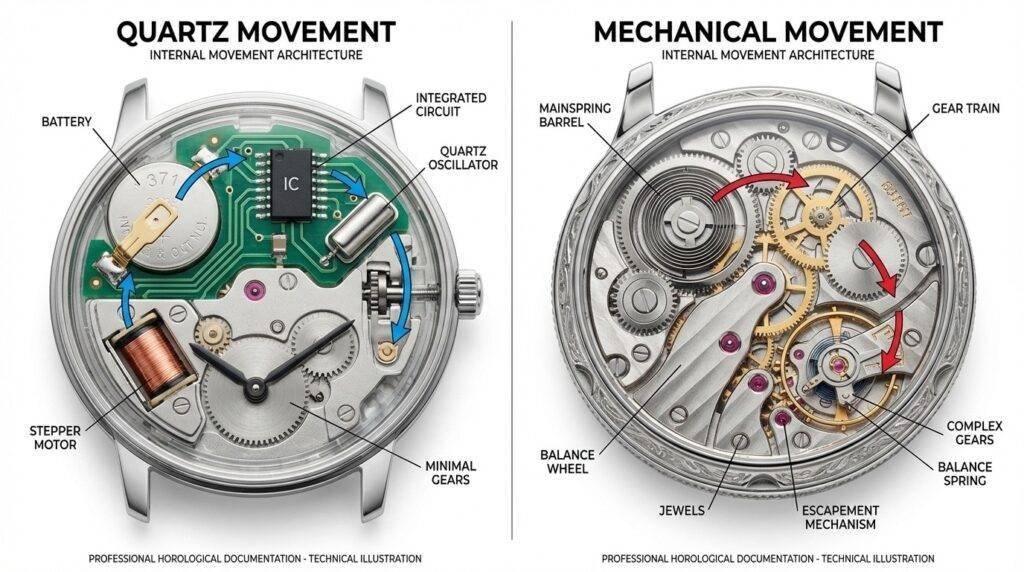
A quartz watch movement stands in stark contrast to a mechanical movement. While the latter uses springs and gears, the quartz watch uses a quartz crystal and an electronic oscillator. The power source is a small battery that sends an electric current through the crystal, causing it to vibrate at a precise frequency. This quartz technology was popularized during the “quartz crisis,” with the first quartz watches offering unprecedented accuracy that no mechanical watch could match at the time.
In a quartz watch, the movement uses a stepping motor to move the hands in discrete, once-per-second jumps. A mechanical watch movement, however, features a sweeping second hand, which is the result of the balance wheel beating several times per second. While a watch with a quartz movement is more accurate and cheaper to produce, it lacks the soul and mechanical artistry found in an automatic mechanical movement. For many, the choice between mechanical and quartz comes down to whether they value “electronic perfection” or “mechanical heartbeat.”
There are several legendary watch manufacturers known to make automatic watches of exceptional quality. Swiss watch companies like Rolex, Omega, and Patek Philippe are world-renowned for their in-house calibre designs. Many other watch companies rely on ETA movements, which are highly reliable Swiss-made engines used by a wide variety of brands. These watch brand giants have refined the automatic movement over decades, ensuring it remains the gold standard for a luxury watch.
On the other side of the globe, Japanese watch makers like Seiko and Citizen have made significant contributions. The Seiko 7s26 movement is one of the most famous Japanese automatic movements, known for being a “workhorse” that can run for years without service. Whether it is a high-end Swiss watch or a durable Japanese automatic, these many movements share the same fundamental goal: to provide reliable timekeeping without the need for a battery.
Choosing between a manual and automatic mechanical watch often depends on your lifestyle. If you enjoy the tactile ritual of interacting with your timepiece every morning, a manual watch is a fantastic choice. These watches need to be wound daily, creating a unique bond between the wearer and the machine. However, if you want a watch to run without constant attention, an automatic watch is the superior type of watch movement for daily wear.
Most automatic watches work best when worn consistently. If the mainspring is fully wound, it will typically have a power reserve of 38 to 70 hours. This means if you take the watch off on Friday night, it should still be ticking on Monday morning. If you have a large watch collection, you might find that your watches need to be wound or kept on a “watch winder” to ensure they are always ready to wear without resetting the time and date.
When we talk about an automatic mechanical movement, we are referring to a system that is entirely “analog.” There are no microchips or batteries within the watch. The movement made by the watchmaker relies entirely on physics—tension, friction, and gravity. This is why mechanical movement enthusiasts are so passionate; it is a marvel that such a small device can keep time using only a coiled mainspring and a series of gear teeth.
Conversely, a quartz watch is powered by a battery. While it is incredibly functional, it doesn’t offer the same level of craftsmanship. The main types of movements are generally categorized into these two camps. An automatic watch represents a bridge between the old world of hand-winding and the modern world of convenience. It is a self-winding watch that rewards the wearer’s activity with constant motion, whereas a quartz watch will eventually die and require a battery replacement.
The debate of mechanical and quartz often comes down to the intended use of the watch. If you need a watch for extreme sports or high-impact activities, a quartz watch movement might be better because it has fewer moving mechanical parts that can be damaged. However, if you are looking for a timepiece that holds its value and serves as a piece of wearable art, the automatic watch is the clear winner.
The automatic mechanical movement is the preferred choice for a luxury watch because of the skill required to assemble it. When you buy a watch with a high-end movement, you are paying for the hundreds of hours of engineering that went into designing the gear ratios and the escapement. For most watch enthusiasts, the smooth sweep of the seconds hand on an automatic wristwatch is far more satisfying than the ticking of a quartz watch.
Building a watch collection is a rewarding journey that often starts with a single automatic watch. As you grow your collection, you will encounter different types of watch movements, from basic Japanese automatic movements to high-complication Swiss calibres. To keep your watch in top shape, it is important to have it serviced by a professional watch repairer every 5 to 10 years. They will clean the parts of an automatic watch, replace old oils, and ensure the mainspring is functioning correctly.
When a watch is fully wound, it performs at its most accurate level. Therefore, if you have an automatic watch movement that you don’t wear often, consider a winder to keep the rotor spinning. This prevents the lubricants from drying out and ensures the watch is always ready for your next adventure. Ultimately, what makes the watch special isn’t just the brand on the dial, but the incredible watch movement hidden inside.
| Feature | Seiko 4R36 (NH36) | Miyota 9015 | ETA 2824-2 | Sellita SW200-1 |
| Origin | Japan | Japan | Switzerland | Switzerland |
| Beat Rate (VPH) | 21,600 (3Hz) | 28,800 (4Hz) | 28,800 (4Hz) | 28,800 (4Hz) |
| Power Reserve | ~41 Hours | ~42 Hours | ~38-42 Hours | ~38-41 Hours |
| Jewels | 24 | 24 | 25 | 26 |
| Accuracy (Daily) | -20 to +40 sec | -10 to +30 sec | +/- 12 to 30 sec* | +/- 12 to 30 sec* |
| Winding Type | Bi-directional | Uni-directional | Bi-directional | Bi-directional |
| Hacking/Hand-winding | Yes | Yes | Yes | Yes |
| Profile Thickness | 5.32 mm | 3.90 mm | 4.60 mm | 4.60 mm |
| Best Known For | Bulletproof durability | Slimness & high beat | The Swiss-made “clone” | The Swiss-made “clon.e.” |



Leave a comment